
 Home
Home
Importers and wholesalers need a systematic method to judge mother‑of‑pearl decor before committing to bulk orders. This checklist breaks down the critical quality dimensions, from raw shell selection to final lacquer finish, that separate premium goods from substandard pieces. Use it to ask the right questions of any Vietnamese manufacturer and to protect your margins against returns, inconsistent finishing, and hidden defects. Browse our full lacquer and mother‑of‑pearl catalog to see real‑world examples that meet these standards.
What Does a Mother‑of‑Pearl Quality Checklist Cover?
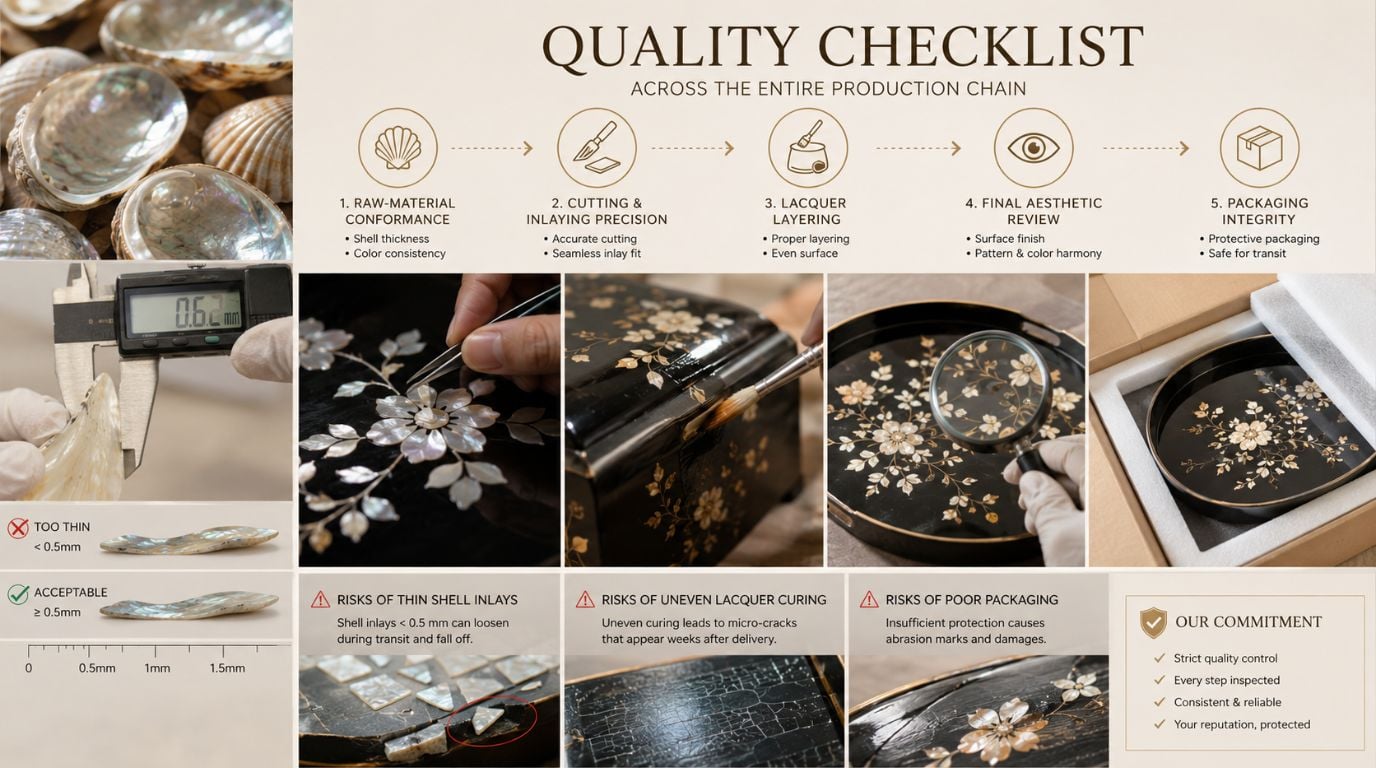
The checklist spans the entire production chain: raw‑material conformance (shell thickness, color consistency), cutting and inlaying precision, lacquer layering, and final aesthetic review. For a B2B buyer, the goal is to catch variations before they become costly, for example, shell inlays that are too thin (<0.5 mm) can loosen during transit, while uneven lacquer curing invites micro‑cracks that surface only weeks after delivery. A proper checklist also examines packaging integrity, because even a perfectly crafted piece loses value if it arrives with abrasion marks.
How Do You Inspect Shell Inlay Thickness in High‑Volume Orders?
Digital micrometers and AQL sampling (e.g., ANSI Z1.4) are the baseline. Measure three points on every sample piece: center, edge, and a high‑stress curve. Our data shows that reliable mass production maintains an average thickness of 0.88 mm with a standard deviation under 0.15 mm. Pieces falling below 0.6 mm should be rejected or reworked. The same inspection applies to every lacquer tray we ship, each batch undergoes this thickness check before the lacquer booth.
Which Lacquer Application and Curing Standards Ensure Durability?
Traditional Vietnamese lacquer demands multiple thin coats, each cured in a controlled environment. Our factory protocol stipulates a minimum of five coats, with each coat receiving 48 hours of drying at 26 °C and 55 % relative humidity. This regime achieves full cross‑linking and prevents future gloss fading or adhesion failure. Ask your supplier to document layer count and environmental logs. To see items that meet this rigorous process, explore our lacquer box collection.
How Can You Identify Common Surface and Structural Defects?
| Defect Category | Symptom | Acceptable Limit |
|---|---|---|
| Air bubbles in lacquer | Small voids visible under oblique light | 0 per premium piece; ≤1 per side in standard grade |
| Uneven shell placement | Visible gaps >0.3 mm between shell fragments | 0 |
| Dull patches | Low‑gloss islands compared with surrounding area | ≤2 patches <5 mm diameter |
| Color bleeding | Pigment transfer from dyed shells to adjacent lacquer | Not acceptable |
| Glue overflow | Yellowish residue along shell edges | Must be clean before final coat |
A simple visual‑touch walkthrough under 500 lux catches most defects. For color bleeding, perform a damp‑cloth rub test on a hidden spot.
What Material Sourcing Standards Should You Require?
Mother‑of‑pearl comes from both sea and freshwater mollusks; the source influences natural iridescence and hardness. Insist on documented origin certificates and batch‑consistency reports. Viettimecraft sources from managed Vietnamese shell farms and maintains thickness‑grading logs for every incoming lot. Visit our main lacquer and mother‑of‑pearl home to download current material compliance sheets.

Frequently Asked Questions
What is the ideal mother‑of‑pearl inlay thickness for mass‑produced decor?
0.8 mm to 1.2 mm offers the best balance of visual depth, resistance to chip‑out, and application speed. Pieces below 0.6 mm risk detachment during shipping, while much thicker inlays can cause uneven lacquer build‑up.
How can I quickly verify lacquer quality on an imported piece?
Conduct a cross‑hatch adhesion test (ISO 2409) on a hidden area and inspect the surface under 500 lux diffuse light for dull spots or micro‑cracks. Request the supplier’s curing log showing batch temperature and humidity for each coat.
Are custom mother‑of‑pearl patterns more difficult to produce consistently?
They require skilled artisans, but with a clear pre‑production sample approval process, consistent output is achievable. Viettimecraft’s OEM/ODM services include up to three prototype iterations and a final sealed reference sample so that every production piece matches your specification.
Why does my decor show small cracks after a few weeks?
Probable cause: insufficient curing time or moisture trapped in the wood base. Always ask for a curing log and humidity records for the substrate before accepting a shipment.