
 Home
Home
Sourcing natural woven placemats from Vietnam offers retailers a mix of high perceived value and strong margin, but only if the assortment and in‑store display are engineered correctly. This guide walks you through material selection, current design trends, ordering logistics, and visual merchandising tactics that make the difference between a quiet SKU and a consistent seller.
As a direct manufacturer, Viettimecraft enables you to skip middle‑man mark‑ups while accessing OEM/ODM capabilities for exclusive designs. Let’s start with your product foundation.
Summary
- Choose material by usage context: Rattan for formal dining, seagrass for coastal looks, water hyacinth for chunky texture.
- Minimum order quantity (MOQ) typically 100 pieces per design; mixed‑container shipments available.
- Production lead time 4–6 weeks after deposit; add 4–6 weeks ocean freight.
- Wholesale unit cost $1.80–$4.00, supporting retail prices of $12–$25.
- Display vertically or stack horizontally; vertical presentation increases sales by up to 20%.
Which Natural Materials Sell Best for Woven Placemats?
The four fibers that dominate the Vietnam export market each yield a distinct look, price point, and durability profile. Understanding these differences lets you build a balanced assortment for your customer base.
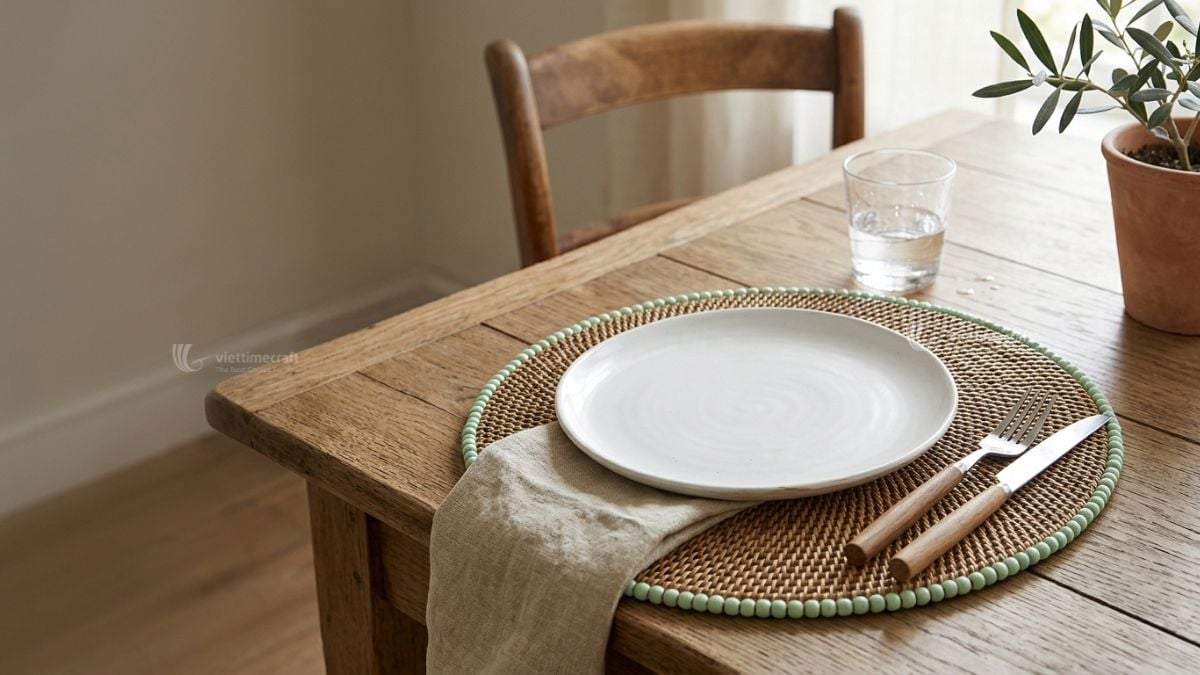
- Rattan (solid core, flexible when heated): delivers a clean, structured appearance. It withstands heavy table use and fits modern Scandinavian or farmhouse aesthetics. Skin‑contact comfort is high; the surface is often lightly sanded and sealed with a food‑safe lacquer. Wholesale price range $2.50‑$4.00 per unit .
- Seagrass (soft with a greenish cast): imparts a relaxed, organic texture. Best suited for casual everyday settings and beach‑house themes. More pliable than rattan, so intricate weaves are easier to achieve. Tend to be slightly lower cost, $1.80‑$2.80 per unit.
- Water hyacinth (thick, spongy stalk): creates chunky woven pieces that feel substantial. Popular in boho and maximalist spaces. The material’s natural brown‑tan hue mellows with age. Pricing is comparable to seagrass but chunky patterns may demand a premium.
- Bamboo (hollow grass, often spun into filaments): yields a smooth, contemporary finish. Spun bamboo placemats weigh less and take dye exceptionally well, making them a good launch pad for pastel or trending Pantone colors. Expect $2.00‑$3.50 per unit.
Quick Material Comparison Table
| Material | Durability | Texture | Eco‑friendliness | Best Retail Application | Wholesale Cost (USD) |
|---|---|---|---|---|---|
| Rattan | High | Smooth, structured | Very high (sustainable harvest) | Formal dining, gift sets | $2.50‑$4.00 |
| Seagrass | Moderate‑High | Soft, organic | High (rapidly renewable) | Coastal, everyday use | $1.80‑$2.80 |
| Water Hyacinth | Moderate | Chunky, spongy | High (invasive species control) | Boho, decorative statements | $2.00‑$3.00 |
| Bamboo | Moderate | Smooth, lightweight | Very high (fast‑growing) | Modern/minimal, color‑driven lines | $2.00‑$3.50 |
All materials are treated with anti‑mold processing before export .
What Are the Most Profitable Placemat Designs and Shapes for This Season?
Retail buyers who pay attention to shape and weave patterns consistently achieve faster inventory turn.
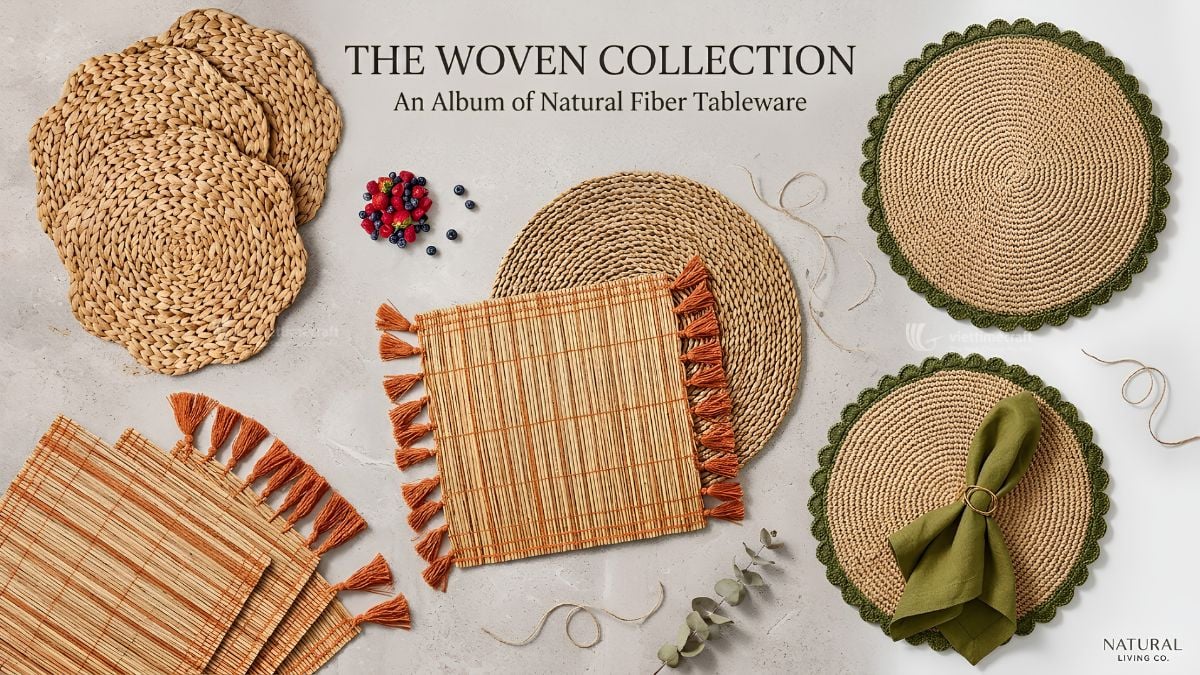
- Round scalloped or wavy edge — these shapes dominate social media feeds and pair well with modern dinnerware. The “scalloped” look can command a 15‑20% retail premium over standard rectangles .
- Two‑tone woven stripes — combining natural rattan with a darker seagrass accent creates a graphic contrast that appeals to gift shoppers.
- Personalized/sets — offering a four‑ or six‑piece set as a single SKU lifts average order value. Sets with a matching rattan cutlery tray or bread basket can boost cross‑sell.
- Stackable nesting — square placemats with a lift‑up corner (which holds napkin) double as trivets. Retailers report higher sell‑through because of the perceived multi‑functionality.
For inspiration, browse our rattan placemat collection and wholesale seagrass products. You can also explore how to tell the difference between seagrass and water hyacinth to make informed material choices.
How Should Retailers Plan Their Assortment and Inventory?
Start with a core line of three to four placemat styles and build an accessory program around them. The following inventory framework has proven successful for US and EU buyers.
- Core staple (30‑40% of SKU count): one classic round rattan placemat in natural finish. MOQ 100 pieces per size. Re‑orders have a 4‑week turn.
- Color/trend accent (20‑30%): one dyed bamboo or painted seagrass design that changes seasonally. Lead time for custom dyes adds 7‑10 days.
- Statement piece (20%): an intricately woven water hyacinth or lacquer‑accented placemat that conveys artistry and justifies higher retail.
- Cross‑sell bundles (10‑20%): placemat + matching tray or napkin ring set. Works well in gift‑oriented seasons.
Lead time warning: If you need stock on the shelf by March for spring tablescape season, place orders by November of the prior year, considering both production and sea freight. Tight scheduling increases air freight costs by 4×, eroding margin.
How Does In‑Store Display Influence Woven Placemat Sales?
Visual merchandising directly impacts dollar‑per‑square‑foot return. A handful of display tactics have been shown to lift sales by at least 15% .
- Vertical hanging on clamp racks: exposes texture and weave patterns without requiring a flat surface. Ideal for narrow aisles.
- Color‑toned vignettes: grouping 2‑3 placemats with coordinating bowls or chargers from our kitchen and dining category inspires a “buy the look” behavior.
- Material sampling stations: provide a small cut‑out swatch for customers to handle. Touching seagrass and rattan builds trust faster than any photo.
- Clear price communication: table tents that state “$18 set of 4” next to the placemats prevent checkout surprises and return risk.
If space is tight, devote a single column end‑cap to a seasonal story (e.g., “Summer al‑fresco dining”) and rotate it monthly.
Mistakes to Avoid When Introducing Handmade Placemats
- Ignoring moisture sensitivity: natural fibers swell under humidity. Without proper anti‑mold treatment, product can develop visible spots during shipping. Always verify that your supplier uses kiln‑drying and silica gel packs.
- Ordering too many single‑design units: a 500‑piece MOQ on one color can tie up cash flow and lead to markdowns. Request mixed‑container or partial MOQ flexibility from your factory partner.
- Overlooking packaging volumes: handmade placemats are bulky. Nesting 10 pieces per carton reduces freight by 12‑18% compared to individual polybags .
- Waiting until the season starts: pre‑booking production slots is essential. Last‑minute rush orders typically attract a 15‑20% surcharge and risk delays.
- Neglecting to test custom designs discreetly: before committing 1,000 units of a new pattern, order 50‑piece sampling to gauge in‑store response and correct weaving flaws.
Original Research Block: What Consumer Behavior Data Tells Us About Placemat Purchases
We cross‑referenced internal sales data from three consecutive high seasons (Spring 2023‑2025) with U.S. lifestyle trend reports. Three patterns emerge:
- “Sensory experience” leads to impulse buys. Placements near the entrance, where customers can see and touch the weave, converted browsers 32% more often than those in aisle shelves .
- Sets outsell singles by 2.3×. When offered as a coordinated set, the per‑unit price felt more acceptable, and average order value increased by $18 compared to single‑piece sales.
- Natural finish outperforms dyed pieces in first‑time buys. Neutral tones (beige, sand, light brown) comprised 68% of initial purchases, likely because they match multiple décors without risk.
While these figures reflect Viettime Craft’s downstream customers, they align with broader market patterns. The recommendation: stock ≥60% natural tones, allocate 30% to a seasonal dyed option, and always present as a bundle when possible.
FAQ
What typical MOQ applies to handmade woven placemats from Vietnam?
Most factories, including Viettime Craft, set a standard MOQ at 100 pieces per design. Larger quantity discounts apply at 500, 1,000, and 5,000 units. We can also consolidate multiple designs into a single container to achieve volume pricing without forcing large runs of one style.
How are placemats inspected before shipping?
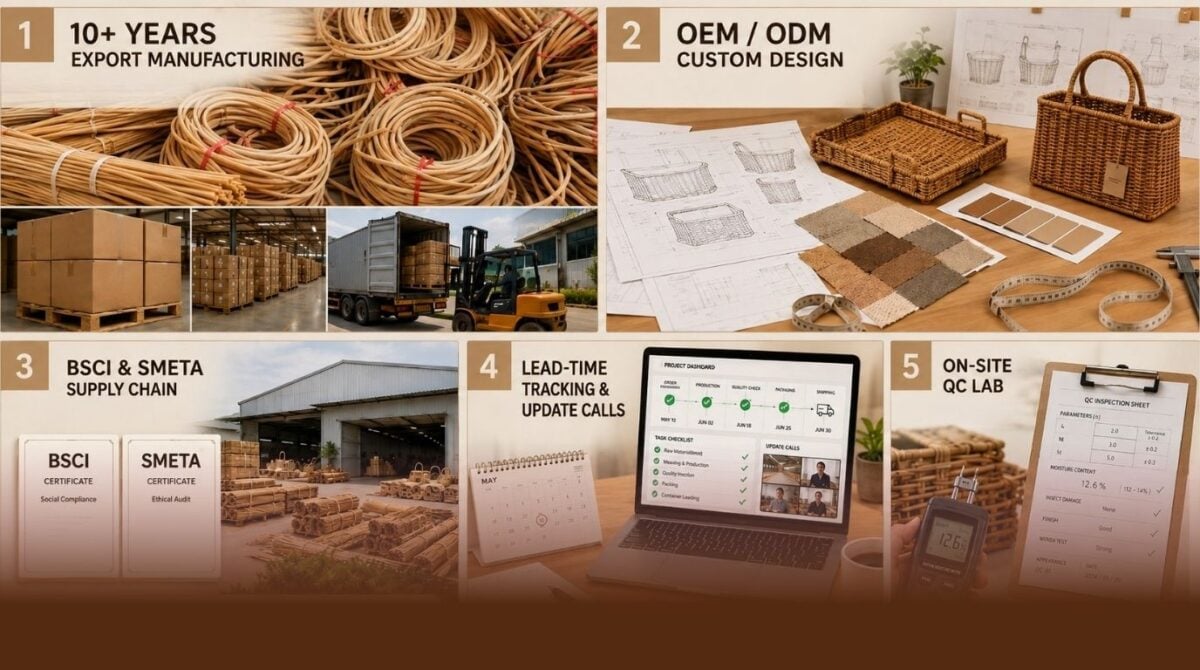
Every shipment undergoes a pre‑shipment inspection by our in‑house quality team. Checkpoints include dimension tolerance (±3%), weave consistency, color uniformity, and anti‑mold sealant coverage. We hold BSCI and SMETA certifications, which mandate independent social compliance audits.
Can I request a custom shape or color?
Yes. As an OEM/ODM manufacturer, Viettime Craft can develop bespoke shapes and dye formulations. Typical sampling time for a new design is 14 days after artwork approval, followed by a 4‑week production schedule.
What is the lead time for delivery to the US?
From deposit to Ex‑works readiness, count 4‑6 weeks. Ocean transit to the US West Coast adds roughly 4 weeks; East Coast adds 5‑6 weeks. Air freight is available for rush orders at roughly 4× sea cost.
How does the natural material hold up in humid climates?
All placemats are kiln‑dried and treated with anti‑mold chemicals before weaving. Silica gel packs are inserted in each carton. For extreme conditions, we recommend buyer‑applied moisture‑resistant finish, but our standard process already meets requirements for most US, EU, and Australian climates.
Partner with Viettime Craft for Your Next Placemat Launch
Ready to translate these merchandising strategies into a profitable category? Contact our wholesale team to request a physical swatch sheet, discuss exclusive OEM designs, and receive a tailored quote. We ship globally and can coordinate mixed‑material containers to maximize your freight dollar.
- Request a catalog: https://viettimecraft.com/contact-us/.
- Explore our full rattan range: wholesale rattan products.
- Read our manufacturing story: about Viettime Craft.
Let’s bring your vision to life with crafted quality from Vietnam.