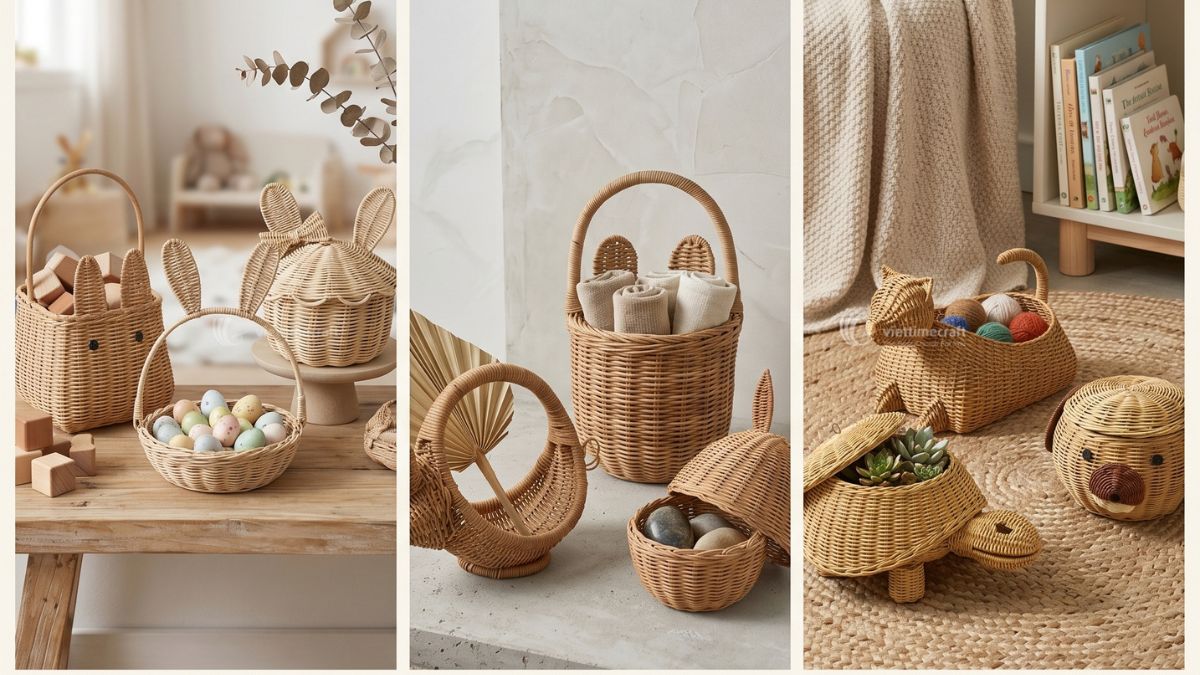
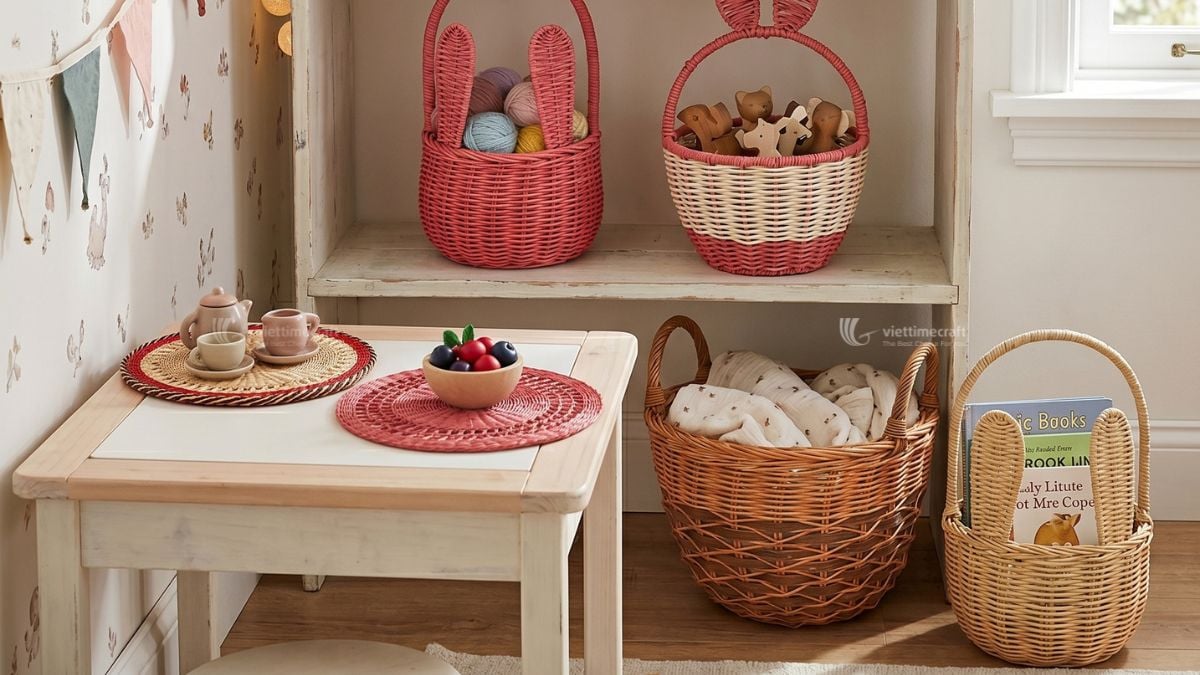
Vietnam has become a primary hub for rattan furniture, baskets, and home decor because it offers mature craftsmanship, cost‑competitive labor, and abundant raw materials. The country accounts for a significant share of global rattan exports, with the US, EU, and Australia being the largest markets . Sourcing directly from a Vietnam‑based manufacturer cuts out middlemen, gives you control over customization, and often reduces landed costs by 15‑25% compared to trading‑company models.
Sourcing rattan products directly from Vietnam manufacturers
For B2B buyers, the key advantage is flexibility: manufacturers like Viettime Craft support OEM and ODM across dozens of product categories, from wholesale rattan products to specialized rattan furniture (tables & chairs) – while maintaining export‑standard quality. You can start with a trial order (MOQ as low as 100 pieces) and scale to full‑container loads once you validate demand.
Factor
Vietnam (rattan)
China (rattan alternatives)
India (rattan & jute)
Labor cost advantage
High
Moderate
Moderate‑high (for handicrafts)
Raw material proximity
Strong (domestic harvesting)
Mix of imports
Domestic bamboo/jute, less rattan
Typical MOQ flexibility
100‑500 pieces
500‑1,000+
200‑1,000
Anti‑mold treatment maturity
Advanced (kiln drying, silica gel)
Advanced
Varies
BSCI/SMETA audit readiness
High (many factories certified)
Varies
Growing but less penetration
How to Evaluate a Rattan Manufacturer
Before committing to an order, assess the manufacturer on five operational pillars:
Certifications: Look for BSCI, SMETA, or ISO 9001. These audits verify labor conditions, environmental practices, and quality management. Viettime Craft, for example, holds BSCI and SMETA certifications and undergoes regular third‑party audits .
Anti‑mold protocol: Rattan is vulnerable to fungal growth if moisture exceeds 12%. The factory must kiln‑dry raw rattan at 60‑65°C for 48‑72 hours and insert silica gel packs into each carton .
MOQ and sampling capability: Reputable suppliers can produce three sample sets (two for buyer approval, one retained at factory) within 10‑15 working days. Always request a sample before volume production.
Packaging design: The best manufacturers engineer stackable/nestable cartons to maximize container space. Viettime Craft uses 5‑ply export‑grade corrugated cartons with drop‑test compliance and mixes flat‑pack items (trays, placemats) with nested baskets to boost loading efficiency
Lead‑time reliability: Standard production lead time for rattan orders is 45‑60 days. Add another 4‑6 weeks for ocean freight to the US West Coast. Clarify whether the lead time covers only production or also includes packaging and pre‑shipment inspection.
What Materials Should You Choose: Rattan vs Bamboo?
Many buyers confuse rattan and bamboo, but they are vastly different in structure, flexibility, and best‑use scenarios.
Criterion
Rattan (solid core)
Bamboo (hollow stems)
Core structure
Solid, vine‑like core that can be bent when heated
Hollow, segmented with nodes
Flexibility for furniture
Excellent – can be molded into chairs, sofas, and intricate curves
Limited – used as slats, poles, or spun bamboo
Durability in humid climates
High if anti‑mold treated
High, but prone to splitting if not properly dried
Typical wholesale applications
Dining chairs, bed frames, trays, baskets, banneton baskets
Lampshades, bowls, placemats, room dividers
Cost
Slightly higher due to processing
More affordable for simple shapes
Rattan’s solid core makes it the material of choice for structural furniture and items that require complex curves. Bamboo, being hollow, shines in spun‑bamboo bowls and lampshades where uniform wall thickness isn’t critical. Understanding this distinction helps you avoid ordering the wrong specification—one of the most expensive mistakes importers make.
What Are the Realistic MOQs and Lead Times?
Actual MOQs depend on product complexity, but here are typical ranges for direct‑factory orders from Viettime Craft:
Building long-term partnerships with Vietnam rattan suppliers
Why mix categories? Viettime Craft’s logistics analysis shows that combining two or three product types in one container can reduce per‑unit freight cost by 10‑15% because dead space is filled with flat or small items .
How to Ensure Quality Control and Anti‑Mold Treatment
Quality control starts at raw material stage and continues through packing. For rattan products, the most critical steps are:
Raw material inspection: Each bundle is checked for cracks, insect damage, and green spots (indicates high moisture). Acceptable moisture content is ≤12% .
Drying process: Rattan slats are kiln‑dried at 60‑65°C for a minimum of 48 hours. After drying, samples are re‑tested with a moisture meter before weaving.
Weaving consistency: Quality supervisors check weaves at least three times per day. Tension must be uniform; any loose weaves are rejected.
Pre‑shipment inspection: An AQL 2.5 (or client‑specified) inspection is performed on packed cartons. Up to 5% of cartons are opened for random testing.
Anti‑mold packing: Finished goods are packed with 5‑10 g silica gel sachets per carton. Cartons are lined with a thin PE film to create a secondary moisture barrier.
If you’re sourcing from a factory that lacks documented moisture control procedures, you risk receiving mold‑damaged inventory after 4‑6 weeks at sea. That’s a top‑three reason for chargebacks in rattan imports.
How to Manage Shipping and Logistics for Rattan Imports
Ocean freight basics
FCL (Full Container Load): A 20‑footer holds roughly 25‑30 m³; a 40‑foot HC holds 65‑70 m³. For mixed rattan orders, aim for a consolidation scheme where heavier furniture constitutes 40‑60% of volume and lighter baskets/trays fill the rest.
LCL (Less than Container Load): Suitable for trial orders (1‑3 m³). LCL freight rates are higher per cubic metre, and multiple handlings increase the risk of damage.
Duty and documentation
Rattan furniture and baskets fall under HS heading 4602. The EU imposes 0‑5.8% duty depending on the specific item; the US tariff is generally around 3‑4% for most rattan home goods .
Required documents: commercial invoice, packing list, bill of lading, fumigation certificate (if using non‑IPPC stamped wood in packaging), and a certificate of origin (Form A or Form E for preferential duty).
Timeline snapshot
Production: 45‑60 days.
Inland transit to port: 2‑3 days.
Ocean transit (Ho Chi Minh → Los Angeles): 22‑28 days.
Customs clearance & delivery: 5‑7 days.
Always pad your supply‑chain plan by two weeks for inevitable port congestion or holiday closures. In 2025, average dwell time at the port of Los Angeles was 4.5 days, but spikes to 8 days occurred during the pre‑Christmas peak .
Common Mistakes When Importing Rattan
Even experienced importers slip on these points:
Not differentiating rattan from bamboo or wicker in the PO. A purchase order that says “wicker chair” can be interpreted as paper rope, PP, bamboo, or rattan—leading to a product that doesn’t match your catalog.
Skipping a pre‑production sample. Without an approved sample stored at the factory, you have no reference for quality checks. Always sign off on a reference sample before bulk production begins.
Ignoring anti‑mold treatment. Insist on a written packing standard that specifies silica gel quantity per carton and PE lining. Ask for photos of the kiln drying process if you cannot visit the factory.
Ordering one product type only. Single‑item containers often leave 20‑30% of the container volume unfilled. Mixed orders are more cost‑effective.
Neglecting packaging optimization. Don’t accept generic cartons. Demand 5‑ply export cartons and nested loading plans. A poorly packed container can raise damage rates to 8‑10% .
Overlooking certification requirements. If your retail partners require BSCI or SMETA documentation, confirm the factory’s audit status early; obtaining a new certification can add 3‑6 months.
Original Research: Optimizing Container Load Mix for Rattan
At Viettime Craft, our logistics team ran a 12‑month analysis of 140 container shipments to determine the optimal product mix for the lowest per‑unit freight cost. Key findings:
Best mix ratio: 40% structural furniture (chairs, tables), 35% medium‑volume baskets (storage, laundry), 25% flat/stackable items (trays, placemats). This ratio reduced empty container volume to under 8% across all shipments.
Nesting baskets alone saved 25‑30% volume compared to fully assembled, non‑nestable designs. Pre‑flattening tray components before packing increased capacity by an additional 10%.
Freight cost reduction: Mixed‑load containers had an average freight cost of USD 0.42 per unit, versus USD 0.58 for single‑product containers (based on a 40’HC FCL rate of USD 4,500 ). That’s a 27% saving per unit.
Exporters who ignore load‑mix planning leave significant margin on the table. When you work with Viettime Craft, our in‑house packing engineers propose a custom load plan for every order, reducing your total landed cost from the first shipment.
Why Partner with Viettime Craft for Rattan Sourcing?
Viettime Craft brings over a decade of rattan manufacturing and export experience. We operate multiple production facilities across Vietnam, staffed by more than 200 skilled workers, and our quality management system aligns with BSCI and SMETA requirements. Our in‑house R&D team (learn more about our R&D team) can handle complex OEM requests, from custom weave patterns to unique staining and finishing.
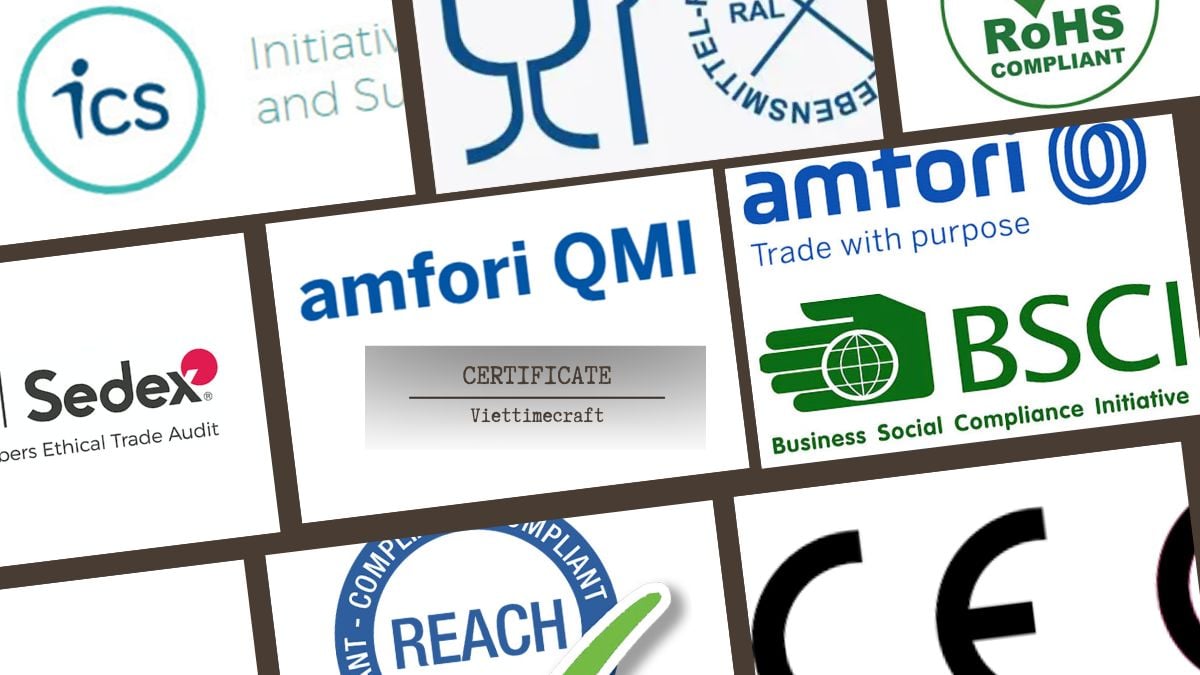
Viettimecraft Export Certifications – A Key Requirement for All Exporters
Key operational advantages:
– Showroom access: Visit our Hanoi showroom to inspect materials and designs before committing to large orders. Read more on our about Viettime Craft page.
– Full‑chain control: From raw rattan harvesting to final carton packing, we oversee every step. Explore our manufacturing process for details on drying, weaving, and QC.
– Competitive MOQs and lead times: Start with 100‑unit orders or scale to multi‑container shipments.
– Sustainability commitment: We use natural, fast‑renewing rattan and adopt eco‑friendly finishing methods. Our facility complies with stringent environmental standards, reinforcing your brand’s green positioning.
Frequently Asked Questions
How long does a typical rattan sample take?
A sample, including sourcing the correct rattan grade and one production iteration, requires 10‑15 working days. Rush service (7‑10 days) is available for an additional fee .
Can I brand my rattan products with custom labels or packaging?
Yes, Viettime Craft offers OEM/ODM services including custom hang tags, brand labels, and branded inner carton printing. MOQs for custom branding typically match the product MOQ, with an additional setup charge.
What certifications does Viettime Craft hold?
We hold BSCI and SMETA certifications, confirming compliance with social and environmental standards. Read more about our certification journey on the BSCI certification page.
How do I avoid mold issues during long‑distance shipping?
We pack each carton with silica gel packs and line it with PE film. Our pre‑shipment moisture check ensures all products are below 12% moisture content. We also recommend clients avoid storage in non‑climate‑controlled warehouses upon arrival.
Where can I see Viettime Craft’s newest rattan collections?
Contact Viettime Craft today to request our latest wholesale catalog and receive a personalized quote. Whether you need a small trial order or a multi‑container shipment, our sourcing team is ready to support your business. Reach out now.

 Home
Home