
 Home
Home
Finding the right Vietnamese rattan factory requires more than scanning a supplier directory. You need to match production capabilities with your market requirements, confirm compliance with international standards, and verify that quality controls prevent moisture damage during transit.
This guide gives you exact checks and questions to use when evaluating any rattan producer, whether you are a first-time importer or a seasoned buyer adding a new origin. We pair real operational facts from our own multi-factory operations with a step‑by‑step audit that eliminates guesswork. By the end, you will know how to separate a genuine manufacturer from a trading agent and how to secure the consistent quality your customers expect.
What Should You Look for in a Vietnamese Rattan Manufacturer?
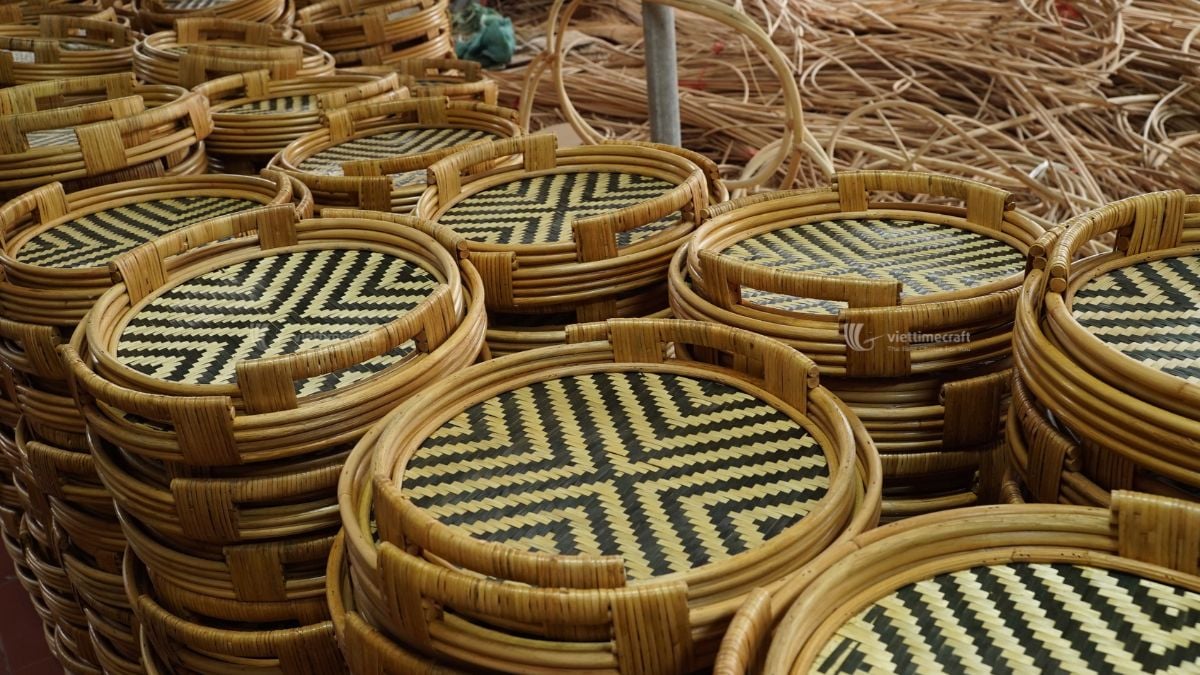
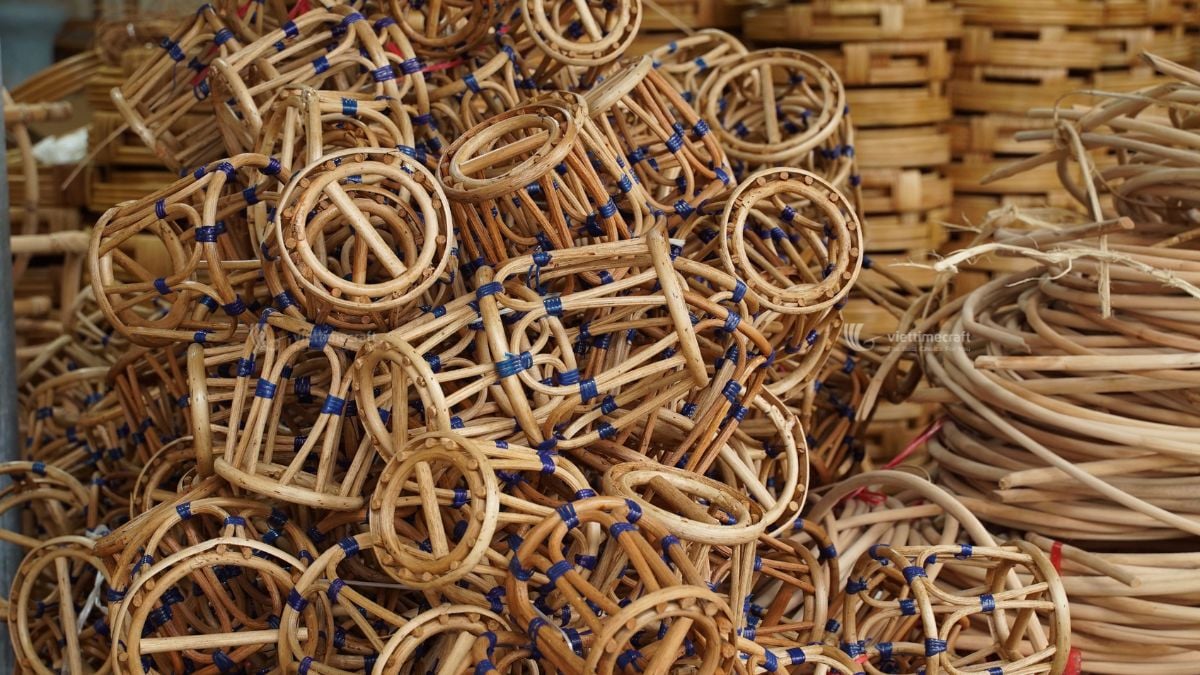
The first filter is operational depth. A genuine manufacturer owns or directly controls at least the weaving, drying, and finishing stages. When you ask about production capacity, they can cite weekly output in pieces or containers, not just “we can handle big orders.” A reliable partner will also have documented anti‑mold steps and a nesting packaging design that saves freight space.
The table below contrasts the typical industry profile with what you can expect from a dedicated, export‑experienced partner such as wholesale rattan products manufacturer ViettimeCraft.
| Factor | Industry Average | ViettimeCraft |
|---|---|---|
| Direct factory control | Often uses sub‑contracted workshops | Owns multiple facilities, controls weaving through finishing |
| Certifications | May lack internationally recognized audits | BSCI, SMETA passed; audit reports available on request |
| Typical MOQ (rattan basket) | 300–500 pieces | 100 pieces on many designs, flexible for ODM projects |
| Production lead time | 45–60 days | 30–45 days for standard baskets after sample approval |
| Packaging | Basic carton, no space‑saving design | 5‑ply corrugated carton, nestable items, moisture‑absorber packets |
| OEM/ODM support | Limited to catalog designs | In‑house R&D team, full custom shape/color/mix |
| Quality checks | Final visual inspection only | In‑line QC at weaving, finishing, and packing stages |
Which Certifications and Factory Audits Matter Most?
When importing rattan to North America or the EU, buyers increasingly demand proof of social compliance and product safety. Certifications such as BSCI and SMETA verify that working conditions, wages, and environmental practices meet international standards. Ask for a copy of the audit report and check the expiry date. A valid SMETA 4‑Pillar audit covers labor, health and safety, environment, and business ethics.
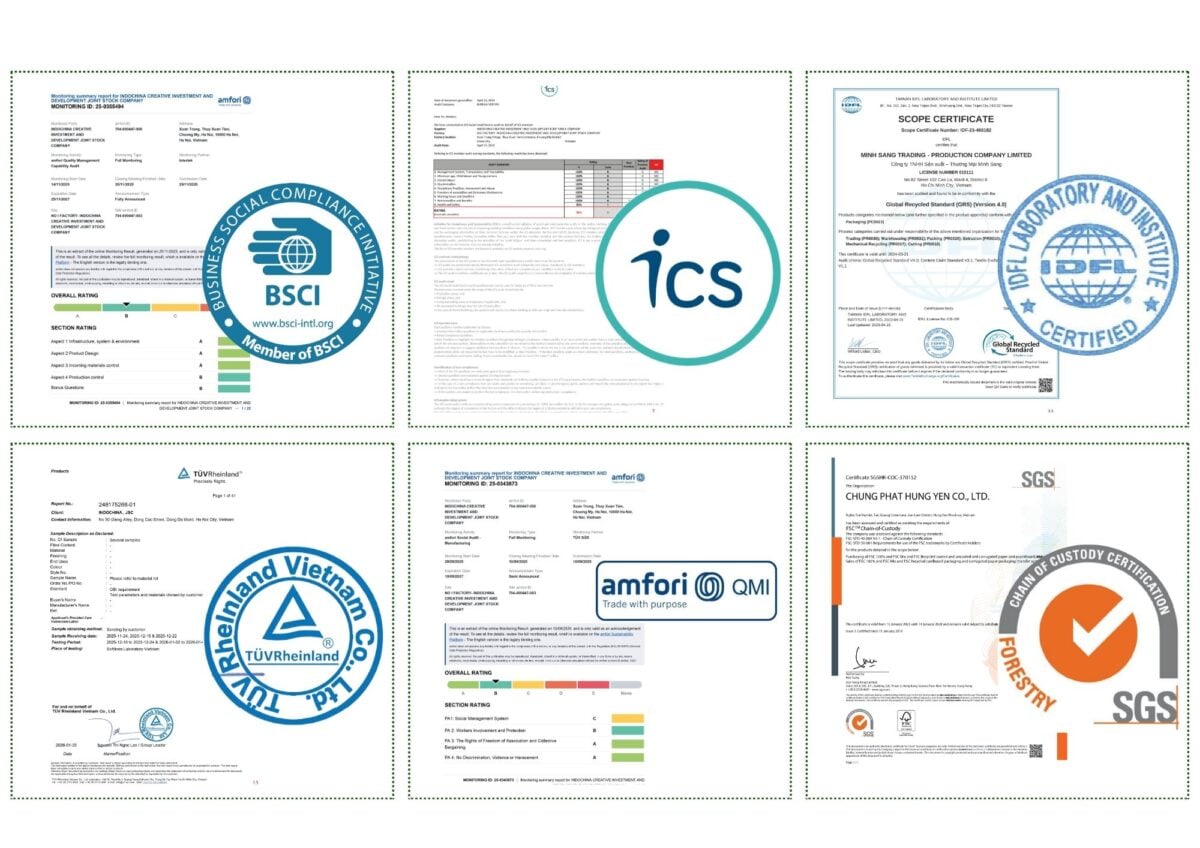
For product safety, confirm that the manufacturer can provide third‑party lab reports for heavy‑metal content (especially for colored or painted rattan) and that they use food‑grade lacquers where applicable. ViettimeCraft maintains BSCI compliance and can supply relevant test reports on request.
Factory audit checklist for your visit (virtual or on‑site):
- Walk through the raw‑rattan drying yard: check moisture content logs.
- Observe weaving stations: look for consistent tension and waste‑sorting.
- Tour the finishing area: confirm ventilation and proper sanding stations.
- Inspect finished‑goods warehouse: cartons should be stacked on pallets, away from walls.
- Ask to see the pest‑control and mold‑prevention log.
How Moisture Control and Anti‑Mold Treatment Protect Your Order
Rattan is a natural material; if moisture content exceeds 12–14% during packing, mold can develop during transit. A trusted manufacturer will:
- Kiln‑dry or sun‑dry raw rattan to below 12% moisture before weaving.
- Re‑check moisture after finishing with hand‑held meters.
- Place silica gel sachets inside each carton.
- Use plastic inner liners for high‑humidity destinations.
- Apply anti‑mold chemical treatment (food‑safe when required) to raw rattan.
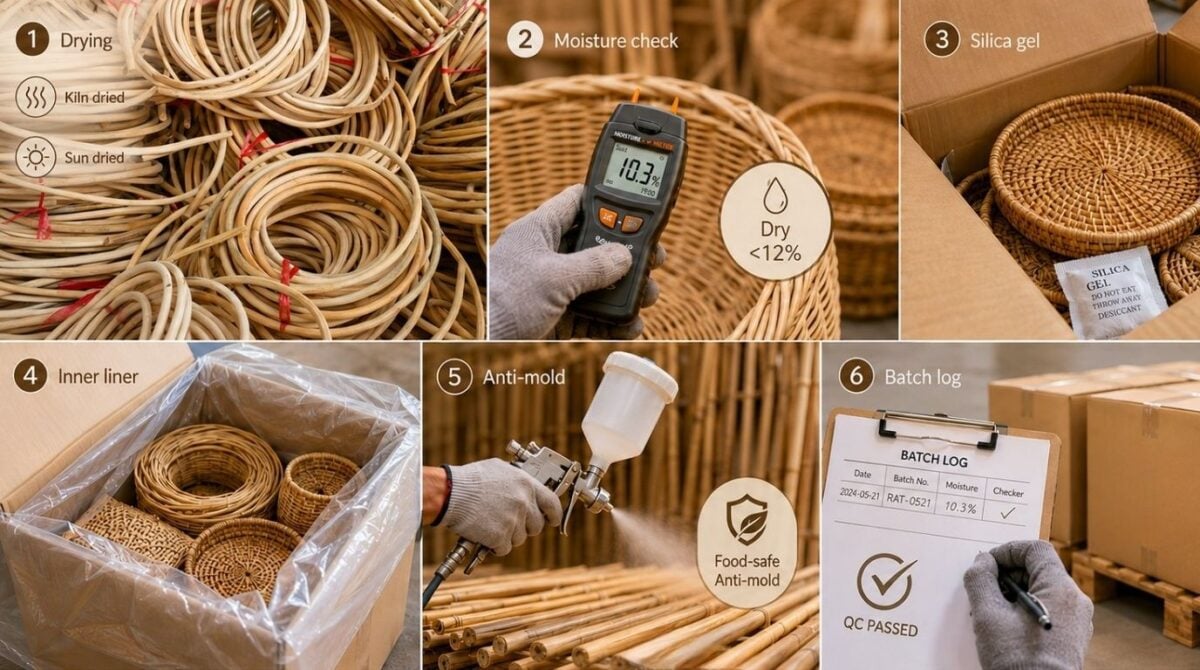
At ViettimeCraft, moisture content is logged at every batch and the final packing stage includes moisture‑absorber inserts . If the factory cannot show you logs, treat it as a warning sign.
Packaging Tactics That Reduce Freight Costs
Ocean freight accounts for a meaningful share of landed cost, so packaging that maximizes container fill is a competitive advantage. Look for:
- Nestable designs: baskets that stack inside one another to reduce volume.
- 5‑ply corrugated export cartons that withstand stacking and port handling.
- Palletization and stretch wrap to keep cartons stable.
- Clear external printing (item code, quantity, buyer reference) to speed customs clearance.
ViettimeCraft’s standard packaging uses non‑dissimilar‑nesting wherever possible and includes internal cardboard dividers to prevent scuffing . This routinely improves container utilization by 15–20% compared with loose stuffing.
Common Pitfalls When Sourcing Rattan from Vietnam
- Relying on catalog photos alone: Photos mask quality inconsistencies that only a hands‑on sample reveal. Always order a production sample before cutting bulk.
- Overlooking import duties and classification: Rattan furniture may fall under different HS codes than baskets; check tariff rates and Lacey Act declarations for plant‑based materials .
- Not pre‑booking ocean freight: During peak season (August–October), space on Asia‑EU lanes fills quickly. Book at least 3–4 weeks in advance.
- Ignoring cultural holidays: Tet (Vietnamese New Year) typically shuts factories for 7–10 days; production schedules must account for this.
- Accepting FOB without clarifying responsibility: Ensure the manufacturer loads containers at their warehouse or named port; confirm who pays THC and documentation fees.
Why Partner with ViettimeCraft?
We operate three manufacturing facilities in key rattan‑craft villages, allowing us to scale volume while keeping skilled artisans employed year‑round. Our in‑house R&D team transforms your sketches into production‑ready samples, and our dedicated QA inspectors follow each order from weaving to container loading. We ship to the US, EU, Australia, and Japan with a track record of on‑time delivery .
What sets us apart:
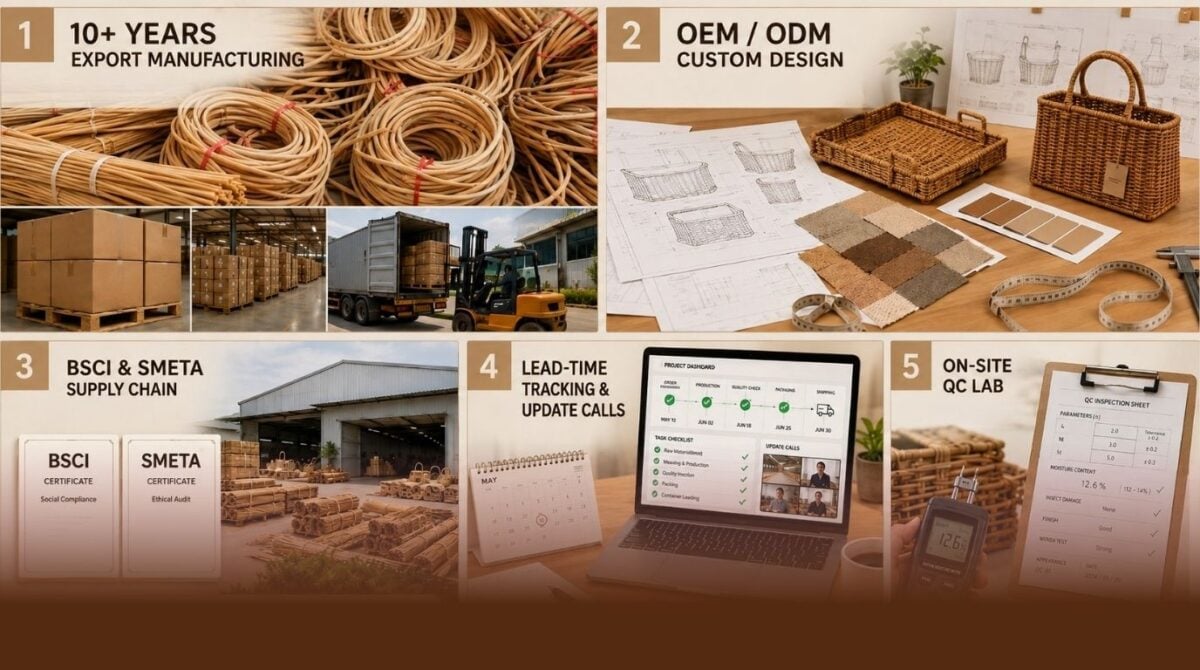
- 10+ years of export‐oriented rattan manufacturing.
- Full OEM/ODM custom design service.
- BSCI and SMETA certified supply chain.
- Transparent lead‑time tracking and regular update calls.
- On‑site QC lab with moisture meters and spec‑sheet verification.
Learn more about our manufacturing process and reach out to request a custom quote or arrange a factory visit.
Frequently Asked Questions
How can I be sure a Vietnamese rattan factory is genuine and not just a trading company?
Request a live video walk‑through that shows the factory name boards, the drying yard, and the weaving floor. Genuine manufacturers will also provide import‑export records or a recent bill of lading with their name as shipper. A middleman will refuse or show a different entity’s documentation. ViettimeCraft regularly conducts live factory tours via video call for prospective buyers.
What is a realistic MOQ for custom‑designed rattan furniture?
Custom OEM orders normally require 100–200 units per design to cover mold preparation and material sourcing. For simpler baskets, MOQs start at 50 units. We always adjust MOQs based on raw‑material accessibility and can offer sampling runs at reduced quantities.
How long does it take from order confirmation to delivery at my warehouse?
Production lead times for rattan baskets average 30–45 days, plus 4–5 days for inland transport to the port and 15–25 days ocean transit to major US ports. Including customs clearance, expect 55–70 days total. During peak season, lead times can extend by 5–7 days .
Are rattan products from Vietnam compliant with EU REACH and US CPSIA requirements?
Yes, when manufactured under proper supervision. We provide third‑party lab reports for restricted substances (heavy metals, phthalates) and use only EU‑approved lacquers. Always request a certificate of compliance for each product family; any responsible factory will have recent test reports available.
What payment terms are typical for first‑time rattan buyers?
The standard arrangement is 30% deposit with order confirmation, 70% balance against copy of the bill of lading (T/T). For larger orders or long‑term relationships, a Letter of Credit (L/C) at sight is also common. We offer flexible terms after establishing a trading history.
Conclusion and Next Step
A high‑quality rattan product starts with a high‑quality manufacturing partner. Use the verification steps, certifications, and checklist in this guide to shortlist suppliers that meet both your compliance and commercial requirements.
If you want to skip the trial‑and‑error phase, reach out to ViettimeCraft directly. We will share our latest catalog, provide sample lead times, and schedule a live factory walkthrough, so you can make the decision based on real production data, not promises.
Request your personalized quote today →