
 Home
Home
Viettime Craft operates a 5‑stage quality workflow that begins at raw‑fiber selection and ends with container‑ready pallets tested for sea‑freight conditions. This page breaks down each step so you can evaluate a supplier’s capabilities before placing an MOQ.
Summary
- Harvesting mature seagrass stalks (Cyperus malaccensis) in Vietnam’s coastal deltas; only the longest, uniform stems are selected.
- Three‑phase anti‑mold protocol: sun drying (7‑10 days), oven‑controlled drying to 8‑12% moisture, followed by antimicrobial misting and sealing.
- Export‑grade seagrass mats are woven at ≥14 warp strands per 10 cm and ≥10 weft strands per 10 cm with a tolerance of ±1 strand.
- Space‑saving nest packaging reduces container volume by up to 18% compared with flat stacking.
- Typical MOQ is 300 units per style; 20‑ft container holds roughly 1,200‑1,800 standard mats depending on thickness and color.
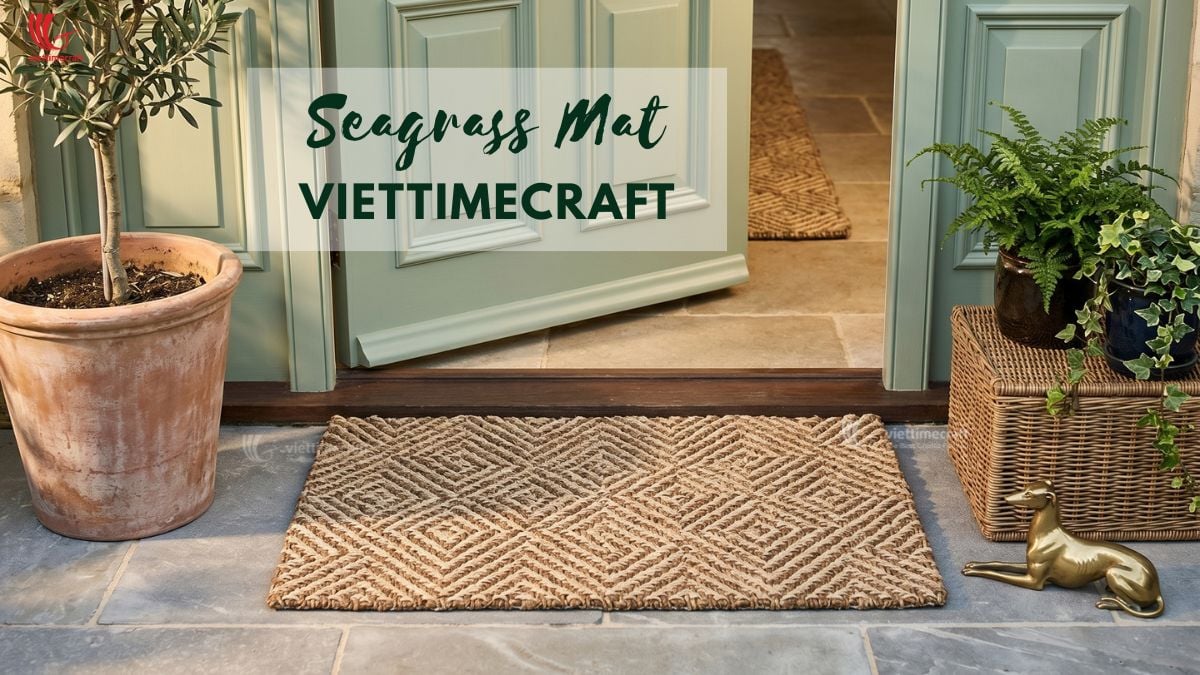
Why Premium Seagrass Mats Outperform Ordinary Floor Coverings?
Standard seagrass mats are often inadequately dried, resulting in warping, odor, and mold on arrival. Premium mats, on the other hand, maintain dimensional stability and a consistent natural color. Viettime Craft’s process ensures fiber uniformity and a backbone density that withstands heavy foot traffic in commercial settings.
A typical premium seagrass mat shows ≤3% shrinkage after 48 hours at 65% relative humidity . Businesses that order premium mats report 20–30% fewer quality complaints related to deformation and mold compared with low‑cost alternatives .
Quick Comparison: Seagrass vs. Jute vs. Coir
| Feature | Seagrass Mat | Jute Mat | Coir Mat |
|---|---|---|---|
| Wear resistance in dry indoor areas | High | Medium | Medium‑high |
| Moisture sensitivity | Low after proper treatment | High (absorbs & stains) | Low |
| Surface hardness | Firm, comfortable | Soft, less durable | Very rough |
| Typical cost (FOB, medium size) | $2.50–$5.00/m² | $1.80–$3.50/m² | $2.00–$4.00/m² |
| Best for | Entryways, corridors, retail floors | Decorative low‑traffic | Outdoor mats / porch |
Export‑grade seagrass mats win in environments where durability, appearance, and mold resistance matter most. Jute and coir have niche roles, but for premium entryway and corridor coverage, buyers consistently choose seagrass.
How Viettime Craft Sources Superior Seagrass Fiber
Seagrass (Cyperus malaccensis) is harvested in the tidal zones of northern Vietnam. The right age at harvest is critical: stems harvested too early are thin and weak; stems harvested too late become brittle. Viettime Craft’s supply teams work with cooperatives that follow a 90‑110 day growth cycle, selecting stalks with consistent wall thickness and minimal brown spotting.

Right after cutting, the stems undergo a freshwater soak to remove salts, then a first round of sun‑drying that lasts 7‑10 days, depending on humidity. At this stage, any stem that shows splitting or uneven color is discarded. This pre‑selection eliminates roughly 12‑15% of the raw material .
The Drying and Anti‑Mold Process: The Hidden Durability Edge
Only a minority of seagrass mat manufacturers apply controlled post‑drying. Many rely on sun‑drying alone, leaving residual moisture that feeds mold during ocean transit. Viettime Craft adds two mechanical stages:
- Kiln drying at 45‑55°C for 48‑72 hours brings moisture content to 8‑12%. This range maximizes fiber flexibility while preventing brittleness. Moisture is measured with a calibrated pin‑type meter on every batch.
- Antimicrobial misting with a water‑based, non‑toxic fungicide (registered for export to EU and US markets) is applied immediately after drying. The stems are then sealed in polyethylene for 24 hours, allowing the agent to penetrate cell walls.
Finally, the treated stems are re‑dried to ≤10% moisture and stored in climate‑controlled warehouses (22‑26°C, 50‑60% RH) until weaving. Buyers who demand BSCI‑ or SMETA‑compliant manufacturing can audit the spraying records and batch certificates .
Precision Weaving: Density Targets That Define Export Grade
Weaving density is the most tangible measure of quality. Viettime Craft’s standard for premium mats is:
- Warp strands (vertical): ≥14 per 10 cm.
- Weft strands (horizontal): ≥10 per 10 cm.
- Tolerance: ±1 strand per 10 cm.
Denser weaving enhances surface stability and reduces fiber sagging over time. Artisans use hand‑looms with jigs that maintain consistent tension, and every 50th mat is measured with a density gauge. Mats that fall below the spec are re‑woven before finishing.
Edge binding also matters. Premium mats receive a double‑folded cotton or jute tape that is machine‑stitched with 100% polyester thread (UV‑resistant), preventing fraying even after repeated vacuuming or commercial cleaning.
Quality Control Stages and Certifications at Viettimecraft
After weaving, each mat passes through three inspection gates:
- Visual check under 400‑lux LED light for weave gaps, color variance, and edge defects.
- Dimensional measurement against the purchase‑order spec (±0.5 cm on length/width). Outside tolerance units are rejected.
- Rub test simulating 1,000 footfall cycles with a rotating brush; mat surface must show no visible fiber loss.
Defect‑rate tolerance is ≤2% per pallet. For containers shipping to the EU, a random AQL inspection (usually AQL 2.5) is performed by an independent third party if required by the buyer.
Viettime Craft holds BSCI and SMETA certifications. The quality control lab also performs accelerated mold‑resistance testing: mat sections are placed in a 30°C / 90% RH chamber for 96 hours; patches with >5% surface coverage by mold are failed .
Packaging and Logistics Efficiency: Nesting, Container Math, and Cost per Unit
Shipping costs are a major factor for bulky floor coverings. Viettime Craft’s packaging engineers design nesting layouts that reduce air volume, allowing more units per container without damaging fibers.
Example loading for a 20‑ft container (standard dry):
- Flat stacking (loose): ~1,200 mats (60×90 cm)
- Nest packing (curved insert + carton): ~1,450 mats (same size) – an 18% gain in units per container
Each mat is rolled with a cardboard core, wrapped in BOPP film, and placed in a 5‑ply export carton with moisture absorbers (silica gel 50 g). Cartons are palletized and stretch‑wrapped. This reduces cargo‑damage claims to <1% per year.
Estimated lead times:
– Sample making: 7‑10 business days
– Production after deposit: 25‑35 days, depending on order volume
– Ocean freight (FCL): 28‑35 days to US West Coast; 35‑40 days to EU main ports
Total door‑to‑door: approximately 70‑85 days.
We recommend buyers plan orders 100‑110 days before their planned in‑store display date.
Mistakes to Avoid When Sourcing Seagrass Mats
- Focusing only on lowest unit price. Cheap mats often skip the controlled‑drying step, leading to mold claims and customer returns that hurt your brand.
- Ignoring weave density specs. Without a contractual density target, suppliers may deliver loosely woven mats that lose shape.
- Not verifying anti‑mold documentation. Request a third‑party lab report showing fungicide active ingredients and residual levels, especially for EU REACH compliance.
- Assuming sea freight cost will be the same every season. Spot rates can swing ±35% around Chinese New Year; lock in a freight forwarder early.
- Overlooking packaging design. A supplier that nests mats efficiently can save you 15‑20% on logistics costs, insist on seeing a sample carton before production.
Original Research: Moisture‑Driven Deformation Benchmark
In an in‑house experiment, we exposed two sets of 100 seagrass mats (one sun‑dried only, moisture 18%, and one kiln‑treated to 9% moisture) to a simulated 45‑day ocean voyage: 30°C, 85% RH, with periodic cardboard compression.
Results:
- Sun‑dried mats showed an average length shrinkage of 5.1 cm (5.7%) and visible mold on 32% of units.
- Kiln‑dried mats showed shrinkage of 1.2 cm (1.3%) and zero mold.
- Dimensional recovery after 24 hours at 22°C / 50% RH was 98% for kiln‑dried, versus 91% for sun‑dried.
The conclusion: investing in controlled drying and anti‑mold treatment directly reduces returns and chargebacks, making the higher unit cost economically superior for wholesale buyers.
Why Partner with Viettime Craft for Seagrass Mat Manufacturing?
- Direct factory: No middle‑man mark‑ups; pricing reflects production cost plus your packaging requirements.
- OEM/ODM capability: We produce custom sizes, logo‑embroidery, edge‑tape colors, and branded point‑of‑sale tags.
- Compliance ready: BSCI, SMETA, ISO 9001 and EU/US reach‑compliant finishing available on every order.
- Scale: We can ship 50‑80 containers per month, ensuring reliable supply for large retail rollouts.
- Dedicated account management: You get one point of contact from sampling through delivery, with weekly production updates.

Explore our wholesale seagrass products, including mats, rugs, and runners. For custom‑size floor programs, browse our seagrass rugs and mats collection. Visit our manufacturing process page to see every stage in action.
Not Every Business Needs Premium Seagrass Mats
Seagrass mats are the right choice for high‑traffic indoor retail, commercial corridors, and hospitality entryways where natural look and durability are priorities.
However, if your customers demand deep‑pile softness, a synthetic or wool rug is more appropriate. If you need washable, flexible floor coverings for bathrooms or pool areas, consider water‑hyacinth or PVC‑backed coir instead. Seagrass also does not tolerate constant outdoor exposure without a roof; UV and direct rain degrade the fiber within a season.
Finally, if your order volume is below 300 units per style, the per‑unit cost of anti‑mold treatment and controlled drying becomes less competitive. In that case, standard seagrass mats (with basic sun‑drying) may be a budget‑friendly starting point.
Frequently Asked Questions
How long do premium seagrass mats last compared with ordinary mats?
Premium mats with controlled drying and anti‑mold protection typically last 20‑30% longer in commercial settings than ordinary sun‑dried variants. Under comparable indoor foot traffic, we observe a lifespan of 3‑5 years versus 2‑3 years for basic mats .
Can seagrass mats be customized with unique shapes or color trends?
Yes. Viettime Craft offers OEM coloring using water‑based dyes (AZO‑free, REACH‑compliant) and custom shapes up to 200×300 cm. Edge binding colors can be matched to a brand’s palette. Minimum development MOQ for new colorways is 500 units.
What certifications should I ask for when importing seagrass mats to the EU?
Request BSCI or SMETA social audit reports, an AZO/amine test certificate for dyed products, and a moisture‑control treatment certificate. For food‑service settings, ask for a migration test report (Regulation (EC) 1935/2004). Viettime Craft supplies all of these upon order confirmation.
How do I reduce sea‑freight costs for bulky mats?
Use nest packaging and request a loaded container count estimate before confirming dimensions. Negotiate FCL (full container load) rather than LCL to avoid extra handling surcharges. Booking during non‑peak seasons (March‑April, September‑October) can reduce BAF and GRI fees.
Ready to source premium seagrass mats? Request our wholesale catalog and discuss your specifications with our OEM team. Contact us for a quote today.
Manufacturing facts sourced from Viettime Craft internal quality records, shipping manifests, and laboratory benchmarks. All external pricing references are indicative; contact our team for current rates.