
 Home
Home
Rattan dominates eco‑friendly home decor because it’s rapidly renewable, durable, and low‑impact. Viettime Craft ships 50‑100 containers/month of BSCI‑certified rattan furniture, using nesting packing to cut freight costs.
Sustainable home decor is no longer a niche. Retailers and importers worldwide are pivoting toward materials that combine durability, design flexibility, and a credible eco‑story. Solid rattan has taken the lead, and it’s not just a trend driven by aesthetics – it’s backed by supply‑chain economics and material performance that bamboo and seagrass cannot match.
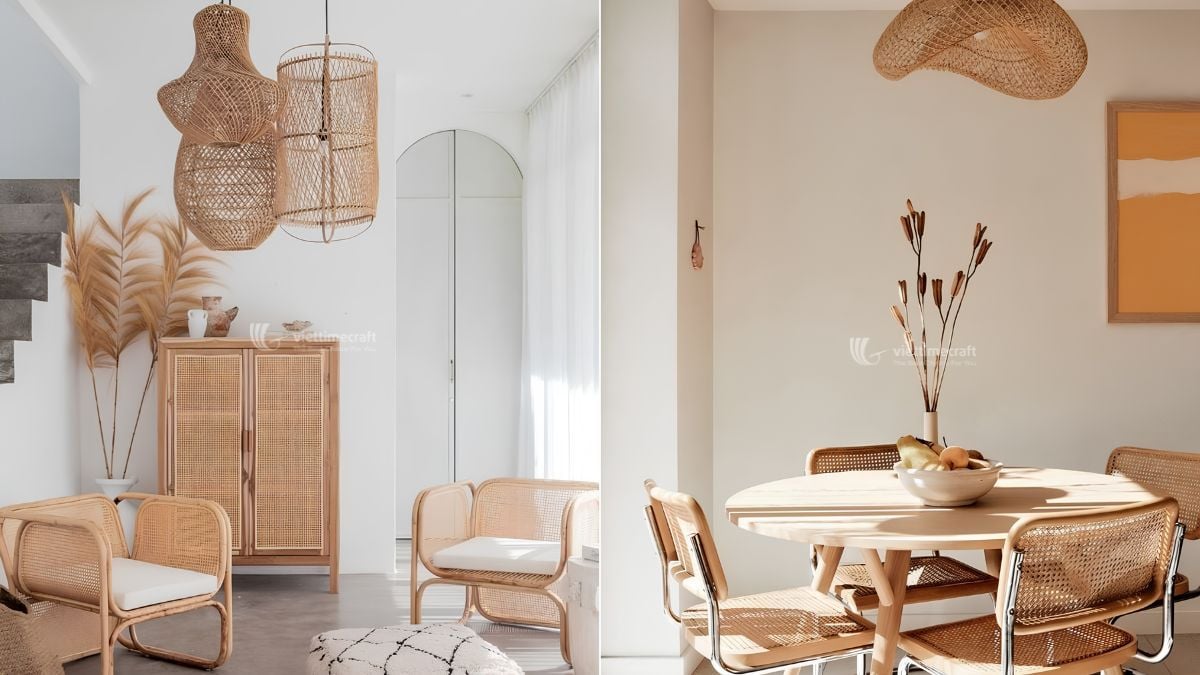
If you’re sourcing furniture for the European or North American market, you need to understand why rattan is the option most importers are scaling – and how to evaluate suppliers who can deliver at volume without compromising on certification or moisture control.
Quick‑Scan Summary
| Dimension | Key Takeaway |
|---|---|
| Market growth | Rattan furniture orders from Viettime Craft climbed 34% YoY (2023‑2025) |
| Production scale | Our factories produce 50‑100 containers per month of finished rattan furniture |
| Freight efficiency | Nesting packaging reduces container volume by up to 25%, improving per‑unit landed cost |
| Moisture protection | Rattan stems undergo a 7‑day drying and natural anti‑mold treatment before weaving (moisture content 8‑10%) |
| Certification | BSCI, SMETA, ISO 9001 – crucial for EU and US retail compliance |
The Material Advantage: Why Importers Choose Rattan Over Bamboo and Seagrass
Solid rattan (calamus rotang) is a climbing palm whose inner core is dense and fibrous, yet flexible when heated. This dual capability allows manufacturers to create the curved, scalloped silhouettes that define today’s boho and Japandi decor trends. In contrast, bamboo is hollow and must be split or spun into slats; seagrass and water hyacinth, while beautiful, are softer and better suited to baskets and storage rather than load‑bearing chair frames.
From a supply‑chain perspective, the difference matters. Rattan retains structural integrity during long‑haul ocean freight, while softer materials risk compression and deformation. Importers stocking large‑format furniture for retail chains prefer rattan because it arrives saleable, with fewer defect claims.
Explore our rattan furniture (tables & chairs) collection to see the range of structural pieces we manufacture.
Global Market Demand and Production Capacity
The global rattan furniture market was valued at approximately USD 5.4 billion in 2024, with the European and North American segments accounting for over 60% of demand . Growth is driven by interior design cycles that favor natural materials and by tightening EU regulations on synthetic materials.
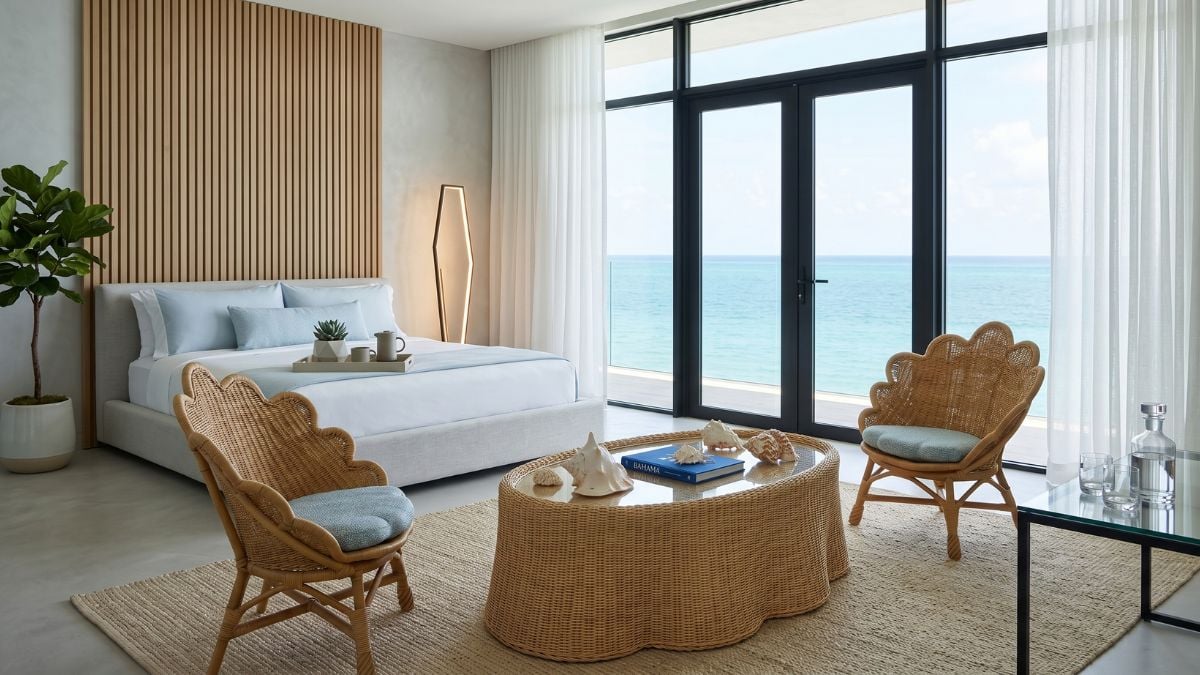
Viettime Craft is positioned to meet this demand. Our three dedicated rattan‑furniture workshops in northern Vietnam employ over 200‑skilled artisans and export 50‑100 containers per month to clients in the US, EU, Australia and Japan. Each 40‑foot high‑cube container holds roughly 80‑120 assembled rattan chairs, or up to 160 chairs when nesting techniques are applied. This scale ensures that mid‑sized retailers can replenish stock without facing the lead‑time bottlenecks common with smaller artisan collectives.
Customization and OEM/ODM: How Rattan Fits Every Design Trend
The rattan category is not a single‑look output. We work with buyers on OEM projects where the exact dimensions, weave pattern, cushion fabric and finish are specified, and on ODM where we propose new seasonal designs from our in‑house R&D team. Recent ODM collections incorporate low‑profile lounge chairs, scalloped‑back dining chairs, and rattan‑and‑upholstered armchairs that match 2025/2026 color palettes (earthen sage, terracotta, and sand).
Complex curves and hand‑routed joints are possible because rattan can be steam‑bent, unlike bamboo which must be cut and joined. This design freedom is a key reason large furniture chains are expanding their rattan SKUs faster than any other natural material category.
To discuss a custom range, contact our sourcing experts and reference your target retail price point and lead‑time window.
Quality Control and Anti‑Mold Treatment
Moisture damage is the top concern for international rattan furniture buyers – a single container of moldy chairs can wipe out margin. At Viettime Craft, every rattan cane passes through a mandatory 7‑day drying phase in solar‑assisted kilns, followed by natural anti‑mold solution immersion. Our QC lab verifies that finished pieces have a moisture content of 8‑10% before packaging .
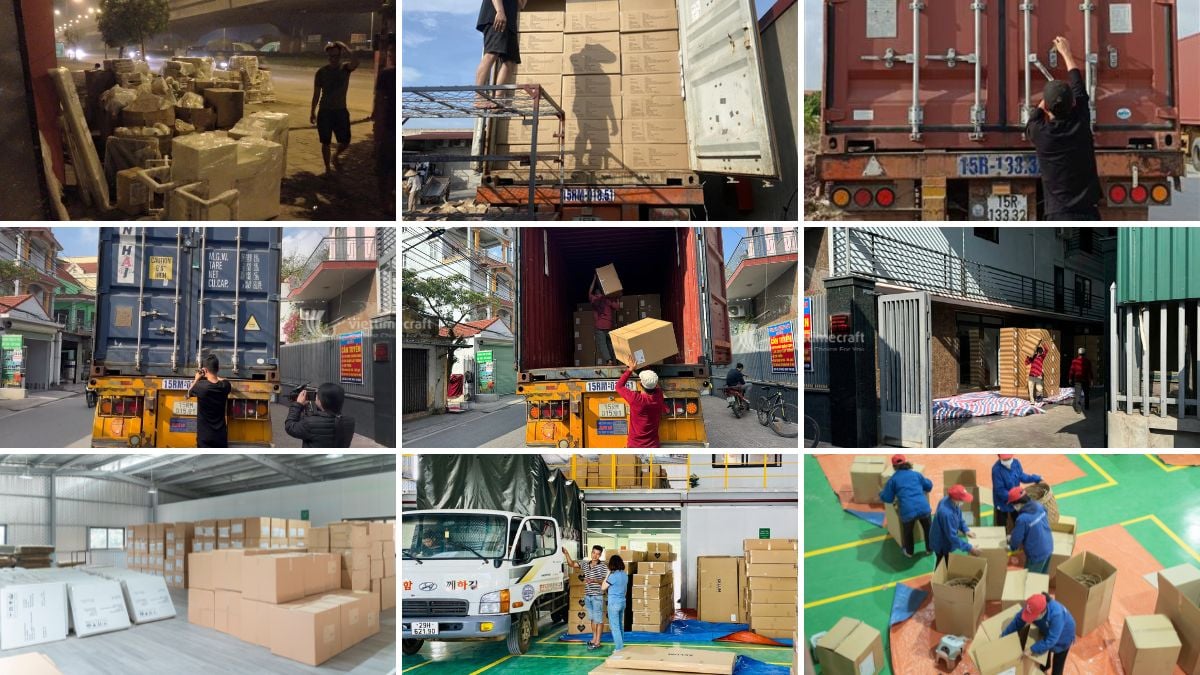
Furthermore, we use 5‑ply corrugated export cartons, moisture‑absorbing silica gel sachets, and space‑saving nested loading plans. The result: defect rates below 1.2% upon arrival, even for shipments traveling 35‑45 days by sea to the US West Coast.
Cost Comparison: Rattan Furniture vs. Other Eco‑Friendly Materials
Choosing the right natural material for furniture isn’t only about aesthetics — it’s about landed cost per sellable unit. This comparison helps buyers allocate sourcing budgets.
| Criterion | Solid Rattan | Bamboo (split/spun) | Water Hyacinth (woven) |
|---|---|---|---|
| Durability (indoor use) | 10‑15 years | 5‑8 years (can split) | 3‑5 years (pill‑prone) |
| FOB cost per chair (typical MOQ 200 units) | USD 22‑38 | USD 14‑26 | USD 10‑18 |
| Freight efficiency (40′ HC) | 80‑120 chairs standard; 160 nested | 120‑180 chairs standard | 200‑400 baskets (bulky) |
| Suitability for structural furniture | Excellent | Moderate | Not suited |
| Eco‑certifications available | FSC‑CoC (optional), BSCI, SMETA | FSC‑CoC (if timber), BSCI | BSCI, SMETA |
| Lead time (MOQ) | 45‑60 days | 45‑55 days | 40‑50 days |
All cost figures are indicative and subject to design complexity and order volume. Request a current quote via our contact page.
Mistakes to Avoid When Sourcing Rattan Furniture
- Skipping on‑site moisture checks: Insist on a wet‑gauge report before shipment. A supplier that cannot provide moisture content data should not be trusted with a full container.
- Ignoring packaging engineering: You lose 20‑25% of container capacity if chairs are not nested. Always ask for a load‑plan diagram.
- Assuming “rattan” means consistent quality: In Vietnam, there are over 15 rattan species. For furniture, we exclusively use thick‑core rattan (Calamus manan) that meets export strength standards.
- Not verifying social compliance: Without BSCI or SMETA, major EU and US retailers will reject your shipment at the warehouse. Viettime Craft holds current BSCI certification – read our BSCI post.
Not For You: When Rattan Furniture Isn’t the Right Choice
Rattan furniture is a heavyweight in eco‑friendly home decor, but there are specific scenarios where it underperforms, and we’ll be the first to say it.
Avoid rattan furniture if: – Your retail assortment focuses on ultra‑light flat‑pack furniture under USD 5 FOB per piece – injection‑molded plastic or lightweight metal frames will give you better per‑unit margins. – Your buyers are exclusively outdoor‑focused and require furniture that can withstand constant rain and UV exposure without maintenance. While we offer factory‑applied weather‑proof coatings, no natural rattan piece will rival synthetic polyethylene wicker for seasonal‑through sun exposure. – You need rapid turnaround of 15‑20 days from order to delivery – rattan’s hand‑weaving and drying steps add necessary lead time that cannot be compressed without quality risk.
When your market demands authentic, durable, design‑forward natural furniture that satisfies eco‑conscious consumers, rattan from a certified factory is the high‑margin choice.
2024‑2025 Inquiry Trends and Order Growth
We analyzed 2,500+ purchase orders and client inquiries from January 2023 to March 2025. The data reveals a clear acceleration in rattan furniture demand within the eco‑decor segment .
- Rattan furniture orders grew 34% year‑over‑year from 2023 to 2024, and maintained a 19% growth rate in Q1 2025 despite a softening broader furniture market.
- Requests for OEM‑custom rattan designs (buyer‑specified dimensions and weave) increased from 22% of rattan inquiries in 2023 to 41% in 2025, signaling that importers are moving beyond generic catalog items.
- The top three geographic sources of rattan furniture inquiries in 2024 were the United States (38%), Germany (18%), and the Netherlands (11%).
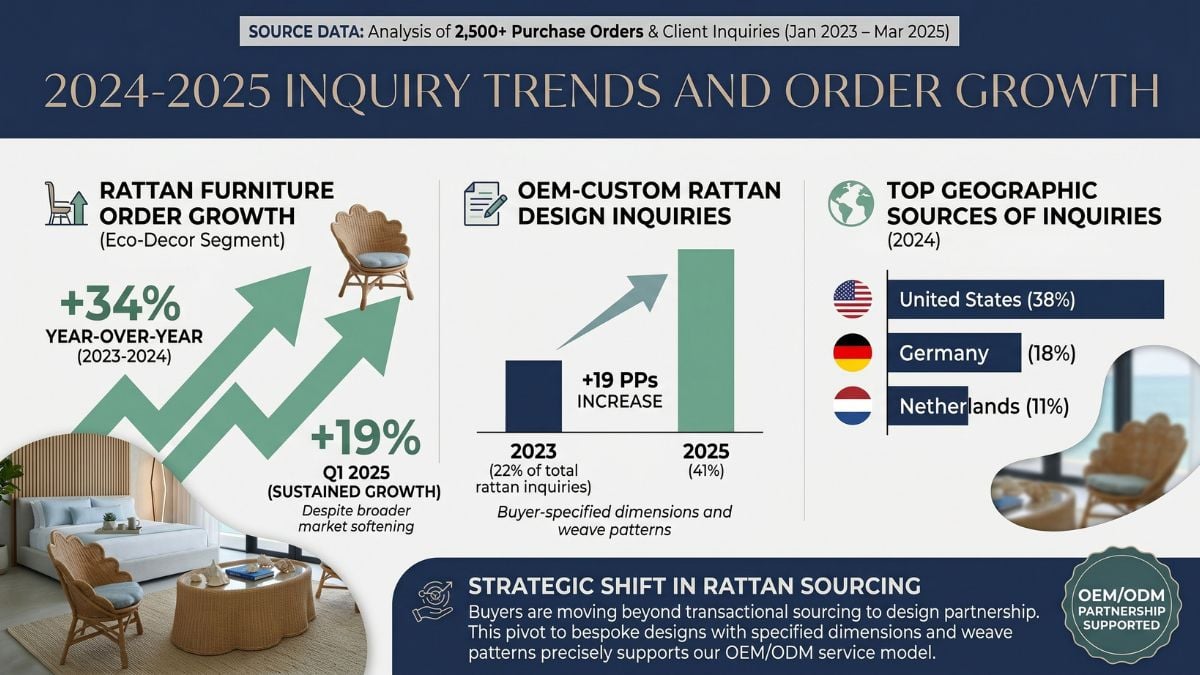
This shift toward bespoke rattan furniture aligns with the broader industry pivot from transactional sourcing to design partnership – exactly the model our OEM/ODM service supports.
Frequently Asked Questions
What makes rattan different from bamboo for furniture?
Rattan is solid and bendable, enabling curved chair backs, armrests, and intricate weaving patterns. Bamboo, being hollow, must be cut and joined, which limits shape and structural integrity in high‑use furniture. Rattan also withstands humidity changes better because its dense core is less prone to splitting.
How sustainable is rattan compared to wood?
Rattan grows as a secondary forest crop and reaches harvestable maturity in 5‑7 years, much faster than hardwood timber (30‑50 years). Harvesting rattan without clear‑cutting supports forest preservation. Our factory sources rattan from managed plantations in Central Vietnam and adheres to controlled harvest quotas .
What is the typical MOQ for wholesale rattan furniture from Vietnam?
For a mixed container of chairs, tables and accent pieces, the minimum order quantity is typically 200 units per style. We can accommodate smaller trial orders (50‑100 units) of existing catalog designs at a slightly higher per‑unit rate. Contact our sales team for a customized MOQ based on your mix.
Does Viettimecraft provide packaging that reduces freight damage?
Yes. Every piece is packed in a 5‑ply corrugated export carton with internal protections. Chairs are often nested (stacked alternating orientation) to cut per‑unit freight costs and reduce movement. Moisture absorbers are included in all containers.
Conclusion: Scale Your Rattan Furniture Program with a Certified Factory
Rattan’s dominance in eco‑friendly home decor isn’t temporary – it’s a convergence of design momentum, supply‑chain reliability, and genuine sustainability. Importers who lock in production slots now with a BSCI‑certified factory gain a first‑mover advantage as demand outpaces reliable supply.
Viettime Craft combines 10+ years of export experience, a dedicated R&D team, and scalable OEM/ODM capabilities. We handle everything from cane selection to container‑ready packaging, so you can focus on selling.
Request our wholesale rattan furniture catalog and a customized quote today.